
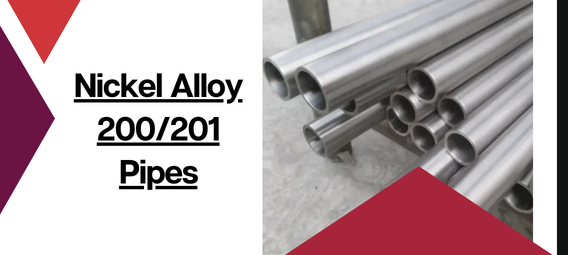
Nickel pipe grades, considered commercially pure, are used in many applications, including marine equipment, food processing plants, toxic soda manufacturing, and several power generation applications where standard steel catches rust quick. The difference between Nickel Alloy 200 and Nickel Alloy 201 is that both pipe grades have a minimum nickel content of 99.6% and nearly identical corrosion resistance. However, the only difference is the content of carbon, indicating which of the two can be used safely. By making a small mistake, graphitization, rusting, or premature failure may occur during high-temperature use.
What Are Nickel Alloy 200 Pipes?
Nickel Alloy 200 (UNS N02200) is processed, commercially pure nickel, carrying up to 0.15% carbon along with trace amounts of iron, manganese, and copper. Below 315°C, it resists caustic alkalis, neutral salts, and reducing acids without measurable attack, which is why caustic evaporators and chlorine-handling lines specify it often. The carbon content also gives Nickel 200 slightly higher room-temperature tensile strength than its low-carbon counterpart. Once service temperature climbs past 315°C, engineers usually switch to Nickel Alloy 200 Pipes instead, since Nickel 200’s carbon precipitates at grain boundaries under sustained heat, weakening the pipe wall over time.
What Are Nickel Alloy 201 Pipes?
Nickel Alloy 201 Pipes are a low-carbon version of commercially pure nickel, produced to UNS N02201 with carbon capped at 0.02% against a minimum 99.6% nickel content. Mills use this tighter carbon limit to stop graphite forming at grain boundaries under welding heat or extended thermal cycling. That change lets Nickel 201 hold up in continuous service to roughly 650°C, well past the 315°C limit for Nickel 200. Tensile strength drops slightly, near 50,000 PSI, yet corrosion resistance against caustic alkalis and chlorides stays steady across both moderate and high-temperature service. Hot caustic evaporators and molten soda lines depend on this grade for that stability.
Difference Between Nickel 200 and Nickel 201 Pipes
Chemical Composition
The carbon content is the key difference between these grades. Nickel 200 allows up to 0.15% carbon. Nickel 201 pipes cap it at 0.02%, roughly a sevenfold reduction. Both alloys share the same 99.6% minimum nickel floor and similar limits on iron, manganese, and copper. That shared base is why both behave almost identically in ambient corrosion service. The carbon ceiling is what mills adjust deliberately, using low-carbon melting practices for Nickel 201 to prevent graphite formation during welding or extended thermal cycling, a risk Nickel 200’s higher carbon budget cannot avoid.
Mechanical Properties
Annealed Nickel 200 Pipe reaches a tensile strength near 55,000 PSI, with yield strength around 15,000 to 20,000 PSI and elongation above 40%. Nickel 201 runs slightly softer, near 50,000 PSI tensile strength, though ductility stays comparable. In actual piping designs, the majority of this small difference is absorbed by wall thickness and schedule selection, so Nickel 201 is rarely ruled out on its own. The gap matters more in fabrication, where nickel 201 welds with less risk of hot cracking since it lacks the carbon that would otherwise segregate at fusion boundaries.
High-Temperature Performance
Nickel Alloy 200 at Elevated Temperatures: Above 315°C, carbon in Nickel 200 migrates to grain boundaries and forms graphite flakes, a process known as graphitization. That graphite network embrittles the pipe, cutting impact toughness and creep resistance under sustained thermal cycling. Nickel 200 is not recommended for continuous service past this point, even though it performs reliably below it for decades.
Nickel Alloy 201 for High-Temperature Service: With carbon held to 0.02%, Nickel 201 resists graphitization up to roughly 650°C. That makes it the standard choice for hot caustic evaporators, molten caustic soda handling, and other processes running continuously above 315°C. The tradeoff is a modest strength penalty at room temperature, one most plant engineers accept for long-term stability under heat.
Corrosion Resistance Comparison
Both grades resist caustic alkalis, dry chlorine and hydrogen chloride gas, neutral and alkaline salts, and most food-processing media with little difference at moderate temperatures. Neither tolerates oxidizing acids like nitric acid well. The structure changes once heat is introduced: Nickel 200 in hot caustic service develops the graphite boundaries described above, and those boundaries become preferential sites for intergranular attack. Nickel 201 avoids that failure mode at the same temperature, which is why corrosion resistance, not just mechanical strength, pushes high-temperature specifications toward the low-carbon grade.
Typical Applications
Applications of Nickel Alloy 200 Pipes: Caustic soda lines running below 315°C, food and beverage equipment, marine hardware exposed to seawater, and electrical components benefit from Nickel 200’s higher strength and lower material cost.
Applications of Nickel Alloy 201 Pipes: Hot caustic evaporators, synthetic fiber production lines, hydrofluoric acid alkylation units, and welded assemblies destined for sustained service above 315°C rely on Nickel 201. For a closer look at where this grade fits into plant design, check below for the breakdown of Nickel Alloy 201 pipe properties, uses, and benefits.
Nickel Alloy 200 vs Nickel Alloy 201 Pipes: Quick Comparison
Carbon content sits at the center of every other difference between these grades. Line them up feature by feature, and the pattern is consistent: Nickel 201 trades a small amount of room-temperature strength for a much higher ceiling on continuous heat exposure.
| Feature | Nickel 200 | Nickel 201 |
| Carbon Content | Up to 0.15% | Up to 0.02% |
| High-Temperature Stability | Limited above 315°C | Stable up to roughly 650°C |
| Graphitization Resistance | Prone to graphitization above 315°C | Resists graphitization at elevated temperatures. |
| Strength | Tensile strength near 55,000 PSI | Tensile strength near 50,000 PSI |
| Corrosion Resistance | Strong below 315°C; intergranular attack risk above it | Consistent across both moderate and high-temperature service |
How to Choose Between Nickel Alloy 200 and Nickel Alloy 201 Pipes?
Start with operating temperature: below 315°C, Nickel 200 covers the job at a lower material cost. Above that, Nickel 201 is the safer specification. Factor in service duration next, since brief excursions above 315°C behave differently than continuous exposure. Mechanical strength requirements matter too. If your design is relying on the higher yield strength of Nickel 200, make sure your temperature profile won’t cause you to change your mind halfway through the project. Some caustic-handling codes require Nickel 201 in high-temperature sections. Nickel 201 has a lower carbon content, which is desired for heavy welding, producing cleaner and more uniform joints.
Conclusion
Carbon content is the single variable separating Nickel Alloy 200 from Nickel Alloy 201, and that variable drives almost everything else: strength, graphitization resistance, and the ceiling on continuous operating temperature. Nickel 200 is well-suited for moderate-temperature caustic and marine service, where its extra strength and lower cost are advantageous. Nickel 201 is the better choice when sustained heat is a factor. Source pipe according to actual operating conditions and applicable codes rather than grade familiarity alone, and work with a supplier like Preston Pipes and Alloys that can confirm mill certifications against your specification.


Whatsapp
+91 9773411691