
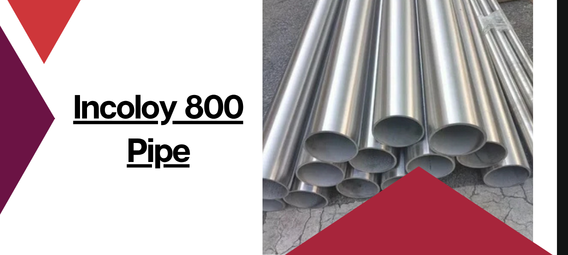
Incoloy 800 Pipes hold their strength and shape, whereas standard stainless steel would sag, scale, or crack under sustained heat. Selecting the correct grade, wall thickness, and form affects safety margins, downtime schedules, and total cost of ownership over years of service.
Temperature ceilings, corrosion exposure, operating pressure, and industry-specific codes all factor into the decision. This guide covers the engineering considerations procurement teams and plant engineers weigh before finalizing an order of Incoloy 800 Pipes.
What are Incoloy 800 Pipes?
Incoloy 800 Pipes are seamless or welded tubular products made from a nickel-iron-chromium alloy, designated UNS N08800 under ASTM B407. Nickel runs 30 to 35 percent, chromium 19 to 23 percent, with iron making up the balance. This gives the alloy an insulating structure that resists oxidation and carburization even after prolonged exposure above 1000°F.
Two related grades exist: 800H, with tighter carbon control for creep strength, and 800HT, which adds aluminium and titanium for extended service. Refineries, power plants, and heat-treating furnaces rely on these pipes for tubing that must hold shape under sustained thermal load.
Why Does Selecting the Right Incoloy 800 Pipe Matter?
A pipe rated for the wrong temperature range fails long before its expected service life ends. Undersized wall thickness leads to bulging or rupture under pressure; the wrong grade in a carburizing atmosphere embrittles and cracks under stress. Either failure mode forces an unplanned shutdown, and replacing embedded process piping mid-campaign costs far more than the material itself.
Correct grade selection also protects welds and joints, since mismatched filler metal or base material accelerates localized corrosion at seams. Matching pipe specification to actual operating conditions, not nominal design values, keeps maintenance predictable and extends service life.
Factors to Consider When Selecting the Right Incoloy 800 Pipe
Operating Temperature
Start by mapping the actual process temperature, not just the design average. Standard Incoloy 800 pipe operates around 1100°F (593°C) in continuous service. Beyond that threshold, switch to 800H or 800HT, engineered with tighter compositional controls for creep and stress rupture. Resistance at sustained high heat. 800HT specifically resists embrittlement through the 1200 to 1600°F range, where standard stainless grades turn brittle with prolonged exposure.
Corrosion Environment
The atmosphere around the pipe matters as much as its temperature: process gases, oxidizing flue streams, and carbon-rich furnace conditions each oxidise the metal differently. Incoloy 800 grades form a stable chromium oxide layer that shields the base metal from oxidation and resists carburization in reducing, hydrocarbon-rich atmospheres. Nickel content adds resistance to chloride stress-corrosion cracking, a failure mode common in standard austenitic stainless steel.
Pipe Type: Seamless or Welded
Seamless pipe, made to ASTM B407, has no longitudinal weld seam and handles higher pressure ratings with fewer inspection variables. Welded pipe under ASTM B514 costs less and reaches larger diameters, since large-bore seamless production becomes impractical. High-pressure steam lines and critical reactor piping specify seamless construction. Lower-pressure ducting, structural runs, and large-diameter furnace piping use welded pipe without sacrificing reliability, provided welds pass 100 percent radiography.
Pipe Size and Wall Thickness
Diameter and schedule follow from flow rate and design pressure, not from what happens to sit in stock. Incoloy 800 pipe is available in small-bore sizes and large-diameter runs beyond 24 inches NB, in schedules from SCH 5 to SCH XXS. Confirm wall thickness against maximum allowable working pressure at operating temperature, since allowable stress drops as heat climbs.
Industry Standards and Certifications
Confirm the pipe carries certification to ASTM B407 for seamless products or B514/B515 for welded products, with the correct UNS designation stamped on the mill certificate. Request Material Test Certificates under EN 10204 3.1 or 3.2, showing heat number, chemical analysis, and mechanical test results.
Fabrication and Installation Requirements
Incoloy 800 welds readily with standard arc-welding processes, but filler metal choice matters: matching nickel-chromium filler avoids galvanic mismatch at the joint. Post-weld heat treatment may reduce residual stress in thick-wall sections before service. Look for flange ratings and gasket compatibility where the new run ties into existing carbon steel or stainless piping, since dissimilar-metal connections require transition pieces.
Choose a Reliable Manufacturer
Metallurgical data on paper means little if the physical pipe does not match it. An established Incoloy 800 Pipe Manufacturer runs PMI, hydrostatic or eddy-current testing, and full mechanical reporting on every heat before dispatch. Confirm stock across sizes and schedules, since custom mill runs for heavy-wall pipe can add months to lead time. Delivery reliability matters as much as metallurgy once a timeline is fixed.
Common Mistakes to Avoid When Selecting Incoloy 800 Pipes
Procurement teams default to standard grade 800 pipe because it costs less, then discover mid-project that operating temperatures exceed 1100°F and demand 800H or 800HT instead. Buying without Material Test Certificates fails to confirm the heat actually matches the ordered grade. Price-driven sourcing decisions, made without checking wall thickness against design pressure, tend to cost more in early replacement than they ever saved upfront.
Conclusion
Getting an Incoloy 800 Pipe right comes down to matching grade, form, and certification to the real operating conditions. None of these factors work in isolation; a pipe correctly rated for heat but undocumented on certification still creates risk. Sourcing from an experienced Incoloy 800 Pipe Manufacturer closes that gap, since consistent metallurgy and verified testing protect the investment long after installation.
Preston Pipes and Alloys supplies Incoloy 800, 800H, and 800HT pipes across sizes and schedules for industrial buyers. Reach out to us with your specification for a stock check and quote.


Whatsapp
+91 9773411691