
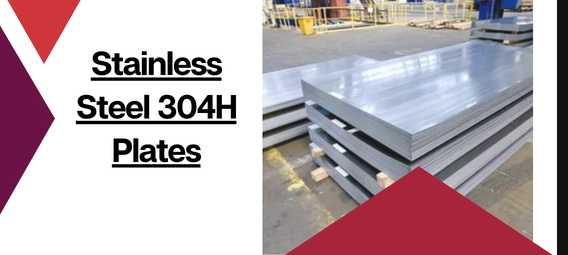
High-temperature industrial environments place materials under conditions that room-temperature service never encounters. Oxidation eats away at surface integrity, creep causes slow permanent deformation under sustained load, and standard alloys lose strength exactly when equipment needs it most. Stainless Steel 304H Plate answers this problem directly. It is a high-carbon version of standard 304 stainless steel, engineered specifically to hold its mechanical properties in elevated-temperature service where the base 304 grade falls short.
What Is Stainless Steel 304H Plate?
SS 304H shares the same 18-8 chromium-nickel base as standard 304, but carbon content runs between 0.04 and 0.10%, compared to a maximum of 0.08% in regular 304 and just 0.03% in 304L. The higher carbon content improves creep resistance by slowing the diffusion processes responsible for deformation at elevated temperatures. 304H Stainless Steel Plate is supplied in plate, sheet, and coil forms, with plate remaining the standard choice for pressure vessel shells, boiler components, and heat exchanger parts where thickness and structural load both matter.
Why the Higher Carbon Content Matters at High Temperatures?
ASME and ASTM standards specifically call out 304H, not standard 304, for pressure vessel and boiler applications operating continuously above 1000°F. Although the increase in carbon content appears minor, it has a significant effect on high-temperature performance. But it directly controls carbide precipitation behavior at grain boundaries during sustained heat exposure. SS 304H performs reliably across a service window of roughly 800°F to 1500°F (427°C to 816°C), holding creep and stress-rupture strength that standard 304 cannot guarantee once ASME Section VIII design codes apply.
The intentional carbon surplus (0.04 to 0.10%) at these high temperatures is a good solution strengthener. It limits the minute motion of dislocations in the crystalline structure. This locking mechanism prevents the metal from creeping under a constant mechanical stress and so protects the structural integrity of high-pressure boiler tubes and piping.
Advantages of Choosing 304H Stainless Steel Plate for Industrial Projects
Service life on 304H plate in continuous high-temperature duty commonly runs 15 to 20 years in boiler and process heater applications. Maintenance requirements drop because the plate resists the scaling and thinning that force early inspection shutdowns on lesser grades. Performance stays consistent across repeated thermal cycling, which matters most in units that start up and shut down regularly rather than running at constant temperature. Fabrication and weldability match standard 304 closely, so shops already tooled for austenitic stainless welding need no special procedures. Compared to nickel-based superalloys rated for similar temperatures, 304H plate costs substantially less per ton while covering the majority of industrial elevated-temperature applications below 1500°F.
Key Properties of SS 304H Plates
SS 304H plates are very useful for high-temperature pressure vessel applications, as they provide a great balance between mechanical strength and thermal stability.
High Temperature Strength
This grade maintains good mechanical qualities from 800°F to 1500°F. The inherent stability of the structure allows larger design permissible stresses under ASME regulations than can be safely used with ordinary 304 at the same temperatures.
Creep and Rupture Resistance
The intentional carbon chemistry of 304H inhibits tiny grain deformation under sustained mechanical strain. This intrinsic metallurgical lock greatly increases the time-to-rupture of the material and avoids premature structural failure in long-term, high-temperature service.
Corrosion Resistance
304H has a minimum of 18% chromium and the same general corrosion performance as ordinary 304. It provides reliable resistance to oxidation and general corrosion in atmospheric environments and many mild chemical process media.
Good Weldability
304H has the same versatile austenitic chemistry of the base alloy and can be readily welded by conventional manufacturing procedures. Special preheating or post-weld heat treatments are not necessary to develop robust, reliable joints.
Oxidation Resistance
The alloy resists scaling and surface deterioration constantly up to 1600°F. It produces a strong, protective chromium oxide coating that resists spalling well under repeated severe temperature cycles.
Dual Certification
Many mills certify plates to be standard 304 as well as 304H. The dual designation provides for significant procurement flexibility, allowing the fabricator to draw from a single inventory stock for both ambient and elevated-temperature design needs.
Why Choosing the Right Supplier Matters?
Certified material with full mill test reports removes the guesswork from a pressure vessel or boiler project where a substandard plate can mean a code violation or, worse, a service failure. Verify mechanical and chemical properties against the actual heat number on the plate, not just the grade stamped on the certificate. Check testing reports for carbon content specifically, since a plate mislabeled as 304H but chemically closer to 304L will not perform to spec at elevated temperature, and confirm ASME/ASTM certification before the material goes into fabrication.
Conclusion
Stainless Steel 304H Plate earns its place in elevated-temperature service through a straightforward metallurgical advantage: higher carbon content that slows creep and preserves strength where standard 304 falls short. Its oxidation resistance, creep performance, and proven reliability in boiler and pressure vessel applications make it the default choice once ASME design temperatures push past 1000°F. Projects running critical high-temperature equipment should choose quality-certified plate every time, and Preston Pipes and Alloys supplies 304H stock backed by verifiable mill certification for exactly that purpose.
FAQs
What is the difference between Stainless Steel 304 and 304H Plate?
Carbon content is the key difference: 304H holds 0.04 to 0.10 percent carbon against a 0.08 percent maximum in standard 304, giving 304H better creep resistance above 1000°F.
What temperature range can SS 304H Plates withstand?
SS 304H performs reliably between 800°F and 1500°F (427°C to 816°C) in continuous service, with oxidation resistance extending to around 1600°F.
Is 304H stainless steel suitable for pressure vessel applications?
Yes. ASME Section VIII design codes specifically reference 304H for pressure vessels and boilers operating at sustained elevated temperatures.
Can SS 304H Sheet Plate be welded easily?
Yes, using standard austenitic stainless welding procedures, since 304H shares the same base chemistry and weldability as regular 304.
Which industries commonly use 304H Stainless Steel Plates?
Power generation, petrochemical processing, and industrial boiler manufacturing all specify a 304H plate for components operating continuously above 800°F.


Whatsapp
+91 9773411691