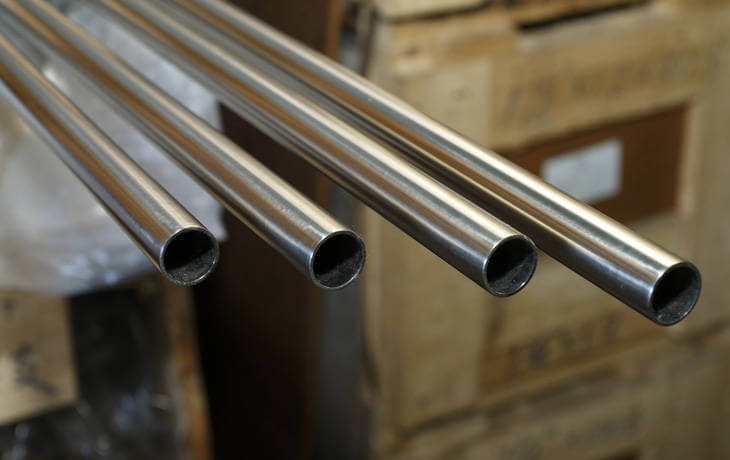
Stainless Steel 316L pipes are manufactured from austenitic stainless steel, featuring a carefully balanced composition of chromium, nickel, and molybdenum. Compared to standard 316 grade, 316L has lower carbon content, which significantly improves its performance in welding applications and prevents carbide precipitation along the grain boundaries. This makes it an ideal choice for industries dealing with corrosive environments, especially where chloride ion exposure is high.
Seamless and fabricated SS 316L pipe combine durability, corrosion resistance, and excellent mechanical properties, making them suitable for a wide range of applications, from chemical processing plants to marine and water management systems.
Key Features of Stainless Steel 316L
- Corrosion Resistance (Chromium Passive Layer Formation)
The chromium content (≥10.5%) in stainless steel reacts with oxygen to form a thin, self-healing oxide layer. This passive film protects the metal from further oxidation, providing superior resistance to atmospheric, chemical, and moisture-driven corrosion compared to carbon steel. - High Tensile and Yield Strength
316L offers reliable tensile strength and yield performance, allowing it to handle structural loads, internal pressure, and mechanical stress without permanent deformation. Its excellent strength-to-weight ratio is especially valuable in austenitic and duplex grades. - Long-Term Structural Durability
The material maintains its mechanical properties over extended periods and resists pitting, crevice corrosion, and surface degradation. This makes it suitable for harsh environments, including marine and heavy industrial settings. - Performance Under Temperature Extremes
Many stainless steel grades retain toughness at sub-zero temperatures and resist scaling at elevated temperatures, making them suitable for cryogenic tanks, heat exchangers, exhaust systems, and furnace components. - Fabrication and Weldability
SS 316L is highly workable for engineering applications. It can be laser cut, plasma cut, rolled, bent, and machined without compromising corrosion resistance, provided proper post-fabrication cleaning and passivation procedures are followed. - Low Lifecycle Maintenance Cost
The self-renewing chromium oxide layer eliminates the need for protective coatings in most environments, reducing maintenance, inspection, and replacement costs over time. - Surface Finish and Hygienic Properties
Available in finishes such as 2B, No.4, BA, and mirror, 316L stainless steel is easy to clean and limits bacterial growth. This makes it ideal for food processing, pharmaceuticals, and cleanroom applications. - Sustainability and Recyclability
316L stainless steel is fully recyclable without losing mechanical or corrosion-resistant properties. A significant portion of new production comes from recycled scrap, supporting circular manufacturing practices.
Benefits of using Type 316L Stainless Steel
- Reduced Welding Sensitization
With carbon content ≤0.03%, 316L minimizes the risk of intergranular corrosion during welding. This ensures welded joints retain their corrosion resistance without post-weld heat treatment in most cases. - Exceptional Corrosion Resistance
316L performs well in aggressive environments, including chloride-rich atmospheres, seawater, and acidic chemical conditions, offering reliable protection against pitting and crevice corrosion. - Enhanced Corrosion Protection with Molybdenum
The addition of 2–3% molybdenum enhances localized corrosion resistance, making 316L ideal for marine, chemical, and pharmaceutical applications. - Selective Weld Annealing for High-Stress Applications
Unlike higher-carbon grades, 316L rarely requires post-weld annealing unless components are exposed to high mechanical or thermal stress, reducing fabrication time and costs. - Comparable Properties to Standard 316
316L retains similar tensile strength, ductility, and toughness as 316, with the added advantage of improved weld performance and reduced risk of intergranular corrosion.
Application of SS 316L Pipes
- Storm Drainage
316L pipes are ideal for storm-water systems in parking lots and landscaped areas, providing durable, high-performance, and crack-resistant drainage solutions. - Subsurface Drainage
Used for underground water transport, 316L pipes help control groundwater levels in sports fields, golf courses, agricultural sites, and hill development projects. - Mining Facilities
Due to their chemical resistance, SS 316L pipes are used in processes for recovering low-grade gold, copper, and silver deposits. - Water Management
Underground stormwater retention systems benefit from 316L’s durability, cost-effectiveness, and aesthetic stability. - Other Industrial Uses
316L pipes are also employed in ventilation systems, floating docks, earth cooling tubes as an alternative to conventional air conditioning, and other specialized applications.
Conclusion
SS 316L pipes from Preston Pipes & Alloys provide unmatched corrosion resistance, mechanical strength, and long-term reliability for industrial, marine, and water management applications. With low carbon content and molybdenum reinforcement, these pipes excel in welded structures and chloride-rich environments while minimizing maintenance.
Choose Preston Pipes & Alloys for high-performance, sustainable SS 316L piping solutions that ensure efficiency, safety, and longevity.
Contact us today to explore our full range of SS 316L pipes and receive expert guidance for your next project.


Whatsapp
+91 9773411691